
Heat Treatment for Export Commodities: Chemical-Free Pest and Microbial Control
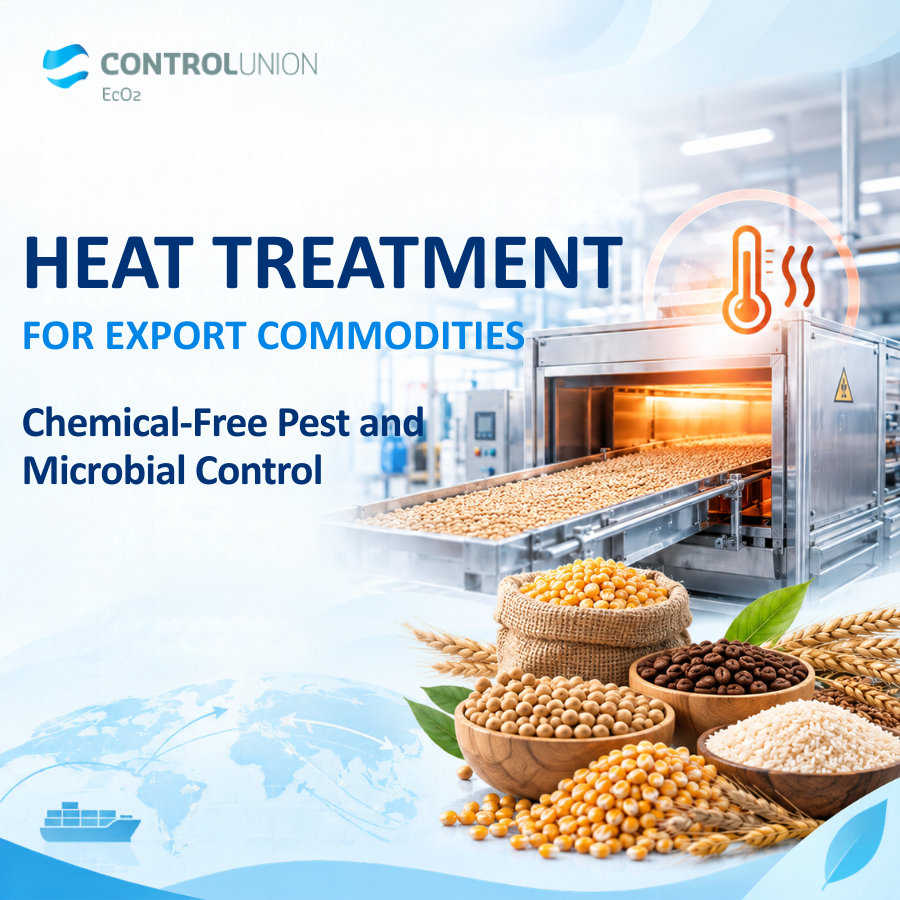
Heat treatment is a chemical-free physical process that raises a commodity, structure or wood packaging to a lethal temperature, typically 56-75°C, and holds it long enough to kill insects at every life stage without leaving residues. For export commodities such as cashews, rice, coffee and spices, it is delivered through microwave in-line systems on the processing line, mobile heaters for empty silos and warehouses, and ISPM 15 treatment for pallets and crates, with temperature data monitored continuously so importers and organic certifiers can audit each treatment.
A container of premium cashews can travel 30 days to Rotterdam, pass every visual check at loading, and still be rejected on arrival because one live weevil crawled out of a sample bag. For export managers, that single insect means demurrage, re-treatment costs and a buyer who quietly starts testing alternative suppliers.
At the same time, the traditional safety net is shrinking, because methyl bromide is restricted under the Montreal Protocol, phosphine resistance is spreading in stored-product insects, and organic standards in the EU, the US and Japan restrict synthetic fumigants on certified product. Exporters who still rely on gas alone are carrying a growing compliance risk, often without realising it.
This guide explains how heat treatment works, where microwave, hot-air and controlled atmosphere methods each fit, and how to build a residue-free protocol that holds up to phytosanitary inspection and buyer audits.
What is heat treatment and how does it protect export commodities
Heat treatment is a physical pest control method that raises the temperature of a product or space to a lethal level and holds it for a defined time, so insects die without any chemical being applied. Control Union EcO2 operates within a 56–75°C range and applies heat either directly to the product, through microwave technology, or to storage and packing spaces through mobile heaters.
The principle is simple, since insects are cold-blooded and cannot regulate their body temperature, which means their internal biology fails once the surrounding heat passes a critical threshold. What makes heat treatment commercially valuable is not the idea itself, which people have used for centuries in grain drying, but the precision with which modern equipment delivers, measures and documents that threshold.
For exporters, the method protects 3 different assets in the supply chain, and each one carries its own risk and standard:
- The commodity itself, such as cashew kernels, rice, coffee beans or spices, treated in-line before packing
- The environment around it, including empty silos, warehouses and packing rooms where residual insects cause reinfestation
- The packaging that carries it, meaning pallets, crates and dunnage that must meet ISPM 15 before crossing borders
Because no gas is used, treated goods can be released immediately after cooling, with no aeration period, no withholding time and no residue analysis to wait for. That speed matters when a vessel cut-off is 48 hours away and a lot has just failed a pre-shipment insect inspection.
How does heat kill insects at every life stage
Heat kills insects by disrupting the molecular machinery that keeps them alive, and the damage accumulates quickly once body temperature passes the tolerance limit of the species. The main biological mechanisms work together rather than in isolation:
- Protein denaturation, where structural and functional proteins unfold and lose their shape, so muscles, membranes and tissues stop working
- Enzyme inactivation, where metabolic enzymes lose activity, halting energy production and respiration
- Membrane disruption, where cell membranes become leaky and lose control of ions and water
- Dehydration stress, where elevated temperature accelerates water loss through the cuticle and spiracles
The practical challenge is that life stages do not respond equally, because eggs and pupae are often more tolerant than adults, and internal feeders such as rice weevil larvae develop inside the kernel where heat arrives last. A treatment that kills every visible adult but leaves eggs alive simply resets the infestation clock by a few weeks.
This is why EcO2 describes its process as reaching deep inside the product to destroy hidden larvae and eggs, not just surface insects. For buyers, the relevant question is never “does heat kill insects” but “was the most tolerant stage, in the hardest-to-heat location, exposed long enough”, and a credible provider should answer that with data.
What temperature and time parameters ensure effective disinfestation
Effective disinfestation depends on a time-temperature combination, since a higher temperature needs a shorter exposure and a lower temperature needs a longer one to achieve the same mortality. There is no single universal schedule for food commodities, because the right setting depends on insect species, life stage, commodity type, moisture content, particle size and packaging.
The clearest regulated benchmark comes from wood packaging, where the IPPC’s ISPM 15 standard sets two schedules:
| Treatment type | Minimum temperature | Minimum continuous time | Where temperature is measured |
| Conventional heat treatment (HT) | 56°C | 30 minutes | Throughout the wood profile, including its core |
| Dielectric heating (DH), including microwave | 60°C | 1 minute | Throughout the entire wood profile |
These values apply only to wood packaging material, and they should not be copied onto cashews, rice or spices without commodity-specific validation. Food products have quality limits that wood does not have, since excessive heat can change colour, oil stability, flavour or germination capacity.
For commodities, a professional provider therefore runs trials to find the lowest effective temperature and shortest effective time that still achieves full mortality of the target pest, then locks those parameters into a written protocol. EcO2’s 56-75°C operating range gives room to set gentler schedules for sensitive products and stronger ones for empty structures where quality is not a constraint.

Why does core temperature validation matter for treatment success
Core temperature validation matters because insects die according to the temperature they actually experience, not the temperature shown on the heater’s display. In a silo, a stack of bags or a pallet, the air can read 70°C while the centre of a 50 kg bag or a thick pallet block is still well below the lethal threshold.
These “cold spots” are where survivors hide, and they are predictable once you know the geometry, typically sitting at the core of dense product, in corners and floor junctions of structures, behind equipment and in the thickest wood components. A validated treatment places calibrated sensors at those worst-case points, not at the most convenient ones.
The treatment clock should start only when the slowest sensor reaches the target temperature, and it should stop only after the full exposure time has passed at or above that level. Any dip below target resets or extends the count, depending on the protocol.
For exporters, this discipline is also a commercial asset, since a temperature log showing every sensor above target for the full hold time is objective evidence for a buyer, an auditor or a port inspector. Without it, a heat treatment is only a claim, and claims rarely survive a rejected container dispute.
How does microwave in-line treatment work for nuts and grains
Microwave in-line treatment passes the commodity on a conveyor through a tunnel where controlled microwave energy heats the product and any insects inside it, disinfesting it continuously as part of the processing line. According to EcO2’s microwave system description, the machine lets operators adjust belt speed and heat output so each commodity, such as cashew, rice or spices, runs at its own optimal setting.
The business case is easy to picture, because a cashew processor packing for an EU buyer no longer has to move finished kernels into a chamber, wait for gas exposure and aeration, then move them back. Instead, kernels leave the grading line, pass through the tunnel, cool and go straight into vacuum bags or cartons, which removes a separate treatment step from the production schedule.
The system described by EcO2 includes several operational features that matter to plant managers:
- Fully automatic operation with safety controls
- Adjustable processing speed and partial heat control for each product
- Humidity regulation that supports drying and preservation
- Low energy consumption and a compact footprint
- Flexible batch sizes that suit both large contracts and smaller orders
This combination positions microwave treatment as a curative step for infested lots and as a preventive step for every lot shipped to residue-sensitive markets.
What makes microwave heating different from hot-air treatment
Microwave heating generates heat inside the material, while hot-air treatment transfers heat from the outside in, and that difference changes speed, uniformity and quality risk. Water molecules are polar, so they rotate rapidly in a microwave field and turn that motion into heat, and because insects contain more water than dry kernels, they tend to absorb energy strongly.
Hot-air systems, by contrast, must first heat the air, then the product surface, then the core, so large or dense loads need long exposure and the surface can overheat while the centre catches up. That makes hot air well suited to empty structures and wood packaging, where quality limits are loose, but less efficient for continuous food processing.
| Factor | Microwave (dielectric) heating | Hot-air (conventional) heating |
| Heat source | Generated inside the material | Transferred from heated air to the surface |
| Typical format | Continuous conveyor, in-line | Batch rooms, silos, warehouses, kilns |
| Speed | Seconds to minutes per pass | Hours for large or dense loads |
| Best fit | Dry commodities on a processing line | Empty structures and wood packaging |
| Key control point | Power density, belt speed, uniformity | Airflow, insulation, cold spots |
Neither method is superior everywhere, so the smart question is which one matches the object being treated.
Which commodities benefit most from continuous in-line processing
In-line processing delivers the most value for dry, free-flowing commodities that already move on conveyors and ship in high volumes to demanding markets. EcO2 names cashew, rice and spices as examples, and these three share a pattern of high value per tonne, strict buyer specifications and frequent exposure to stored-product insects.
Cashew kernels are a strong fit because they are graded, peeled and packed in continuous lines, and because EU and Japanese buyers expect insect-free, residue-free product. Rice benefits because weevils and moths often develop inside grains, where internal heating reaches them more directly than surface methods.
Spices and dried herbs are attractive because many are sold as organic or clean-label, and because some buyers restrict fumigant use on them. Other dry products, such as coffee beans, cocoa, dried fruit, seeds or other tree nuts, can also be evaluated, although each needs trials before commercial settings are fixed.
The weaker candidates are products with very high moisture, uneven piece size or heat-sensitive oils that degrade quickly, since uniform heating becomes harder to guarantee. A practical rule is to start with a pilot lot, measure mortality and quality side by side, then scale only once both targets are met.
How does microwave treatment achieve microbial reduction without residues
Microwave treatment can contribute to microbial reduction because the same heat that kills insects also stresses bacteria and mould spores, while the humidity control lowers moisture that microorganisms need to grow. The key word is “contribute”, because disinfestation and microbial reduction are different technical objectives with different validation requirements.
Killing a weevil requires a lethal temperature for a short time, while achieving a documented reduction of a specific pathogen usually requires a validated process with defined temperature, time and moisture, verified by laboratory testing. A treatment designed only for insects should not be marketed as a pathogen kill step for food safety plans without that evidence.
What heat does offer, unlike fumigants, is a residue-free path, since nothing is added to the product and no breakdown compounds remain afterwards. Drying also helps storage stability, because lower moisture and water activity slow mould growth during long ocean transit through humid tropical ports.
For buyers, the credible approach is to separate claims clearly, stating insect disinfestation as the primary outcome and treating microbial reduction or drying as secondary effects that are confirmed per product through testing.
Can heat treatment replace chemical fumigation for organic exports
Heat treatment can replace chemical fumigation for most routine disinfestation of organic and residue-sensitive exports, but it cannot automatically replace a fumigation that an importing country specifically mandates for a quarantine pest. That distinction is the first thing an export manager should check, because the destination’s import permit, not the exporter’s preference, decides which treatment is legally required.
For the large share of shipments where no specific fumigant is prescribed, the argument for heat is strong. Methyl bromide is controlled under the Montreal Protocol as an ozone-depleting substance, and the EU has banned it for almost all uses, including quarantine and pre-shipment fumigation, since 18 March 2010, while phosphine remains widely used but faces documented insect resistance and residue limits in many markets.
EcO2 states that its non-toxic methods comply with the organic rules of the EU, USDA-NOP, JAS, Bio Suisse and Naturland, which is precisely the certification set demanded by premium buyers in Europe, the United States and Japan. For an organic cashew or spice exporter, that alignment turns pest control from a risk into a selling point.
The practical conclusion is a layered approach, using heat or controlled atmosphere as the default, keeping conventional fumigation only where a regulation requires it, and documenting every decision so certifiers can follow the logic.
Why are premium buyers rejecting fumigated commodities
Premium buyers are moving away from fumigated commodities because residues, even within legal limits, create commercial, reputational and certification risks they no longer want to carry. Many European retailers apply private residue specifications stricter than legal maximum residue levels, so a lot that is technically legal may still fail a buyer’s internal test.
Organic buyers face an even harder line, because the use of a prohibited synthetic fumigant on certified product can lead to loss of organic status for the lot, and investigations can reach back through the whole supply chain. One contaminated container can cost an importer more in lost certification than the shipment itself is worth.
There is also a brand dimension, since food companies increasingly publish sustainability commitments on chemical use, worker safety and ozone protection, and they expect suppliers to support those claims with evidence. A supplier that can say “treated with heat, no fumigant, temperature log attached” makes the buyer’s reporting easier.
Finally, phosphine resistance is a quality issue as well as a regulatory one, because resistant insects that survive fumigation arrive alive at destination, creating exactly the rejection the treatment was meant to prevent.
How does heat treatment maintain organic certification compliance
Heat treatment supports organic compliance because it is a physical method that adds no substance to the product, which fits organic rules that put preventive, physical and mechanical pest control first, such as the USDA-NOP facility pest management standard (7 CFR 205.271), EU Regulation 2018/848 and JAS. The method itself does not create a residue, so there is nothing for a laboratory to detect.
Compliance, however, depends on the whole system rather than the heat alone. The treatment site must prevent commingling with conventional products, equipment must be cleaned between lots when required, and any cleaning agents used in the facility must also be permitted under the relevant organic standard.
Exporters should also inform their certification body about the treatment method before the first run, since most certifiers want pest control procedures described in the organic system plan. That short step prevents questions during the annual inspection.
It is equally important not to overstate the claim, because heat treatment does not make a product organic, and it cannot rescue a lot that was already fumigated with a prohibited substance. It simply allows certified product to be protected without putting that certification at risk.
What documentation proves residue-free treatment to importers
The strongest proof of residue-free treatment is a complete treatment record that shows what was treated, how, when, by whom and with what measured result. Importers and certifiers trust data more than declarations, so documentation should allow a third party to reconstruct the treatment without calling the provider.
A robust documentation pack for heat-treated exports typically includes the following items:
- A treatment report with lot numbers, commodity, quantity, date, location and operator
- The time-temperature log from calibrated sensors, showing the hold time above target
- Sensor calibration records and sensor placement notes
- A statement that no chemical fumigant was used on the lot
- Organic transaction or certificate references, where applicable
- Optional residue test results from an accredited laboratory for buyers who request them
For wood packaging, the ISPM 15 mark on each unit serves as the international proof, but for food commodities the report and log are what carry the weight. EcO2 notes that its treatment parameters are continuously monitored and collected, which gives exporters the data they need for this pack.
How does heat treatment compare to fumigation and controlled atmosphere
Heat treatment is the fastest of the three methods, controlled atmosphere is the gentlest for large stored volumes, and chemical fumigation is the most familiar but carries residue, resistance and safety burdens. The right choice depends on what is being treated, how much time is available and which market the goods are going to.
Controlled atmosphere (CA) works on the same “nothing survives” logic as heat but from the opposite direction, flushing gastight chambers, containers, tents or silos with nitrogen or CO2 until oxygen falls below 0.5%. Fumigation relies on a toxic gas, usually phosphine today, which must be handled by licensed operators and aerated before release.
| Criterion | Heat treatment | Controlled atmosphere (CA) | Chemical fumigation (phosphine) |
| Mechanism | Lethal temperature, 56–75°C | Oxygen below 0.5% via N2 or CO2 | Toxic gas exposure |
| Typical duration | Minutes (microwave) to hours (hot air) | Several days to weeks | Several days plus aeration |
| Chemical residue | None | None | Possible, subject to MRLs |
| Insect resistance risk | Low (physical mode of action) | Low (physical mode of action) | Documented and spreading |
| Organic compatibility | Yes (EU, USDA-NOP, JAS per EcO2) | Yes (EU, USDA-NOP, JAS per EcO2) | Not permitted on certified product |
| Best fit | In-line processing, empty structures, wood packaging | Large stored lots, bulk and bagged goods, silos | Where regulation mandates it |
| Worker safety | Heat and electrical controls | Asphyxiation controls | Toxic gas handling and licensing |
In practice, many exporters combine methods, using microwave treatment on the line, CA for long-term storage of bagged stock, and heat for periodic sanitation of empty warehouses.
What are the throughput and integration differences between methods
Throughput is where heat treatment, especially microwave in-line, separates most clearly from the alternatives. A continuous tunnel treats product as it flows, so capacity is measured per hour, while CA and fumigation are batch processes measured per chamber cycle of several days.
That difference shapes plant layout and working capital, because a batch method needs space for product waiting to be treated, product under treatment and product being aerated. For a processor running tight shipment schedules, three days of stock sitting in a chamber is capital that cannot be invoiced.
Integration effort also differs, since microwave systems must be engineered into the existing line with the right belt width, speed and cooling section. CA requires gastight enclosures and a gas supply but little change to production, and mobile heaters need only power, access and sensor placement.
The practical way to decide is to map where infestation risk enters the chain, then place the treatment at that point. If insects arrive with raw material, treat on intake or on the line, and if they come from the facility, sanitise the building with mobile heat.
Which method best protects product quality during treatment
Controlled atmosphere is usually the gentlest method for product quality, because it changes the gas environment rather than the product temperature, which makes it well suited to heat-sensitive or high-value stock stored for long periods. Microwave heat treatment, when properly calibrated, protects quality by keeping exposure short and heating selectively.
The quality risks of heat are real but manageable, including moisture loss, colour change, oil oxidation in nuts and reduced germination in seeds meant for planting. These are controlled by setting the lowest effective temperature, limiting exposure time and cooling product promptly after treatment.
Fumigation does not heat the product, but it brings its own quality concerns, since residues can affect buyer acceptance and some commodities absorb odours or gases. Resistance can also mean surviving insects continue feeding after treatment.
The decisive step is a side-by-side trial on the exporter’s own product, measuring mortality, moisture, colour, taste and, where relevant, germination before and after treatment, so the choice rests on data rather than assumptions.
What is the heat treatment process from assessment to treatment report
A professional heat treatment follows seven stages, starting with a technical assessment and ending with a treatment report that can stand up to an audit. Skipping any stage, especially assessment or verification, is the most common reason a treatment that “should have worked” leaves survivors.
The standard EcO2-style workflow runs in this order:
- Assessment, reviewing commodity, volume, packaging, target pest, facility layout, destination market and organic status
- Protocol design, setting target temperature, hold time, sensor positions and acceptance criteria
- Setup, installing or configuring the microwave line, mobile heaters, fans, insulation and calibrated sensors
- Treatment, raising temperature to target and holding it for the defined exposure time
- Monitoring, logging every sensor continuously and correcting deviations in real time
- Verification, confirming all sensors met criteria and, where agreed, checking insect mortality with bioassays
- Reporting and follow-up, issuing the treatment report and advising on hygiene to prevent reinfestation
For silos, EcO2 applies mobile heaters before loading rice, flour or other grains, targeting eggs and larvae hidden in gaps and surfaces. For packing and storage areas, the same equipment supports periodic sanitation of the processing environment.
How is equipment integrated into existing processing lines
Equipment integration begins with a line survey, because the microwave tunnel has to match the belt width, product flow rate and layout of the existing grading and packing sequence. The goal is to insert treatment where product is already clean, sorted and close to final packing, so nothing can reinfest it afterwards.
Engineers typically check four points before installation: available floor space and access for maintenance, power supply capacity, the cooling section needed after heating, and the transfer points between existing conveyors and the tunnel. Poorly designed transfers can create spillage or bottlenecks that undermine the throughput advantage.
For mobile heat treatments of silos, warehouses and packing rooms, integration is lighter but still planned, since heat-sensitive items such as plastics, electronics, lubricants and fire sprinklers must be identified and protected. Doors, vents and gaps are sealed or insulated so heat stays where it is needed.
A well-integrated system should need little daily attention once commissioned, since operators load settings for each commodity and the machine holds them, which is why EcO2 emphasises fully automatic operation and adjustable speed and heat for each product.
What temperature monitoring and verification standards apply
Temperature monitoring standards depend on what is being treated, with ISPM 15 setting the clearest rules for wood packaging and commodity protocols relying on validated, documented procedures agreed with the buyer or authority. In both cases, the core principle is the same, which is that the coldest measured point decides whether treatment succeeded.
For wood packaging, ISPM 15 requires the core schedule to be reached and held, and national plant protection organisations authorise or accredit the treatment providers. In the Philippines, for example, the Bureau of Plant Industry accredits providers treating wood packaging for international trade, and similar approval systems exist in other exporting countries.
For commodities and structures, a sound monitoring standard includes calibrated sensors with traceable calibration certificates, sensor placement at predicted cold spots, logging intervals short enough to capture fluctuations, and alarms for sensor failure or temperature drops.
Verification then compares the full data set against acceptance criteria set before treatment began. Where a buyer asks for extra assurance, live insect bioassays, meaning cages of test insects placed at cold spots, provide biological proof that the temperature achieved was lethal.
What should a complete treatment report include for audits
A complete treatment report should allow an auditor to verify the treatment independently, without relying on the provider’s word. That means it must identify the lot, describe the method, prove the result and name the responsible people.
The report should contain lot and container identifiers, commodity and quantity, treatment date and location, method and equipment used, target temperature and hold time, number and position of sensors, the full time-temperature log or a summary with the raw file attached, and any deviations with the corrective action taken.
It should also carry the operator’s name and signature, the provider’s accreditation details where relevant, and a clear statement that no chemical fumigant was used. For organic products, referencing the lot’s organic certificate or transaction certificate links the treatment to the certification chain.
Keeping these reports in a searchable archive pays off later, because when a buyer raises a complaint months after shipment, the exporter can respond within hours with evidence instead of assurances.
How do you calculate ROI for heat treatment investment
ROI for heat treatment is calculated by comparing its total cost of ownership with the full cost of the current method, including the losses that current method fails to prevent. Comparing only the price per tonne of treatment is the most common mistake, since it ignores downtime, rejections, stock holding and certification risk.
A simple annual framework can be written as follows, and every figure in it should come from the exporter’s own records rather than industry averages:
Annual net benefit = (Current treatment cost + Rejection losses + Stock-holding cost + Certification losses) − (Heat treatment cost + Energy cost + Maintenance cost)
Here, the current method’s cost includes treatment fees, aeration time, licensed operator charges and residue testing, while the loss terms capture rejected or re-treated shipments, working capital tied up during batch treatments, and premiums lost when product cannot be sold as organic or residue-free.
EcO2 describes its microwave system as compact, with low energy consumption and a fast return on investment. The actual payback for a given plant depends on volume, product value and how much the current method is costing in hidden losses, which is why a site assessment with real data is the only reliable basis for a business case.
What cost factors should processors compare beyond treatment price
Processors should compare at least eight cost factors, because a method that looks cheaper per tonne can be more expensive once operating realities are counted. The most important factors to measure are these:
- Throughput and downtime, meaning how many hours of production or storage capacity each method consumes
- Working capital, meaning the value of stock held during batch treatment and aeration
- Energy use, calculated per tonne treated at realistic line speeds
- Labour and licensing, including specialised fumigation operators and safety supervision
- Maintenance and calibration of equipment and sensors
- Residue testing required by buyers for fumigated lots
- Re-treatment frequency, especially where resistant insects survive fumigation
- Market access value, meaning price premiums or contracts that depend on residue-free or organic status
The last factor is often the largest and the least measured, because it appears as revenue rather than cost. A processor that wins a single organic contract because it can prove residue-free treatment may recover more than a year of treatment spending.
The best practice is to build a comparison table using twelve months of actual data, then run the same volume through each method on paper before committing to equipment.
How does reduced export rejection impact total cost of ownership
Reduced export rejection has an outsized effect on total cost of ownership because a single rejected container can wipe out the margin of many successful ones. When a shipment fails at destination for live insects or residues, costs stack quickly through re-treatment, demurrage, return freight or destruction, and a discounted resale if the goods can be sold at all.
The damage also extends beyond the shipment, since importers record supplier incidents, and repeated problems can move a supplier from preferred status to probation. For exporters selling into the EU, border notifications can increase inspection frequency on later shipments from the same origin.
Heat treatment lowers this risk in two ways, by killing insects at all life stages before shipment and by providing a documented temperature record that shortens any dispute. Because there is no chemical residue, a whole category of residue-based rejection disappears.
To quantify this in a business case, exporters should list every rejection, claim and re-treatment over the past two or three years, assign the full cost to each, and estimate what share heat treatment would have prevented. That number, not the treatment fee, is usually what determines whether the investment pays back.
What do most competitors miss about heat treatment for commodities
Most content about heat treatment treats it as one generic service, which hides the three decisions that actually determine whether it works for an exporter. The first gap is the failure to separate commodity, facility and wood packaging treatment, even though each has different standards, equipment and risks, and ISPM 15 values are often wrongly applied to food.
The second gap is the silence about validation, since many pages promise “100% insect kill” without explaining cold spots, sensor placement or the most tolerant life stage. A buyer who asks “where was the coldest sensor and for how long was it above target” will quickly separate professional providers from equipment sellers.
The third gap is the absence of a system view, because heat treatment is most powerful when combined with CA for long storage, facility sanitation to stop reinfestation, and documentation that feeds organic and buyer audits. Treating one lot perfectly achieves little if it then sits for a month in an infested warehouse.
A contrarian but useful question for any exporter is therefore not “should we switch from fumigation to heat” but “which point in our chain lets insects in, and which method closes that point permanently”. That reframing usually produces a lower total cost than any single-method answer.
Why does EcO2’s Asia-Africa presence matter for regional exporters
EcO2’s presence across Asia and Africa matters because commodity exporters need treatment capacity close to origin, where infestation risk is highest and shipping deadlines are tightest. Our company was founded in the Netherlands in 2000, opened its second office in Vietnam in 2006 with its Control Centre and factory, and joined Peterson & Control Union, a network spanning 70 countries, in 2010.
The project record shows where that experience sits, with 18,096 cashew treatments carried out in Vietnam and Ivory Coast and 1,730 tobacco treatments across the Philippines, Malaysia, Indonesia and Turkey. EcO2 also lists operations in African and Middle Eastern markets including Mozambique, Ivory Coast, Tunisia and Dubai, alongside Asian markets such as India, Indonesia and Singapore.
For a cashew exporter in West Africa or a spice processor in Southeast Asia, this means working with a team that already understands local commodities, climate, port conditions and the expectations of European and Japanese buyers. It also means technical support and equipment knowledge built in the same region where the goods are produced, rather than imported advice.
Experience measured in thousands of completed treatments is harder to fake than a brochure claim, and it is what buyers and auditors look for when they assess a supplier’s pest control.
What mistakes cause heat treatment failure in export operations
Most heat treatment failures come from process shortcuts rather than from the technology itself, and they are predictable enough to prevent with a checklist. The most frequent mistakes seen in export operations are these:
- Measuring air, not product, so the log looks perfect while the core of bags or pallets never reaches target
- Starting the clock too early, before the slowest sensor has reached the lethal temperature
- Copying ISPM 15 settings onto food, which can either underdose pests or damage product quality
- Skipping trials, then discovering colour, oil or moisture changes only after a full commercial lot is treated
- Treating the lot but not the building, so product is reinfested in the warehouse before loading
- Weak documentation, leaving no proof when a buyer disputes a shipment
- Overstating claims, such as promising pathogen elimination or organic status without evidence
Each of these is avoidable through a written protocol, calibrated sensors at worst-case points, a pilot run and a complete treatment report. When a provider cannot explain how it prevents each of them, that is a signal to keep looking.
Ready to upgrade from fumigation to premium market access
Every season that an export business stays dependent on fumigation alone is a season spent carrying residue risk, resistance risk and the chance of a rejected container at the worst possible moment. The exporters winning organic and premium contracts in Europe, the United States and Japan are already moving to residue-free treatment, and buyers increasingly expect suppliers to follow.
Heat treatment gives you a faster, cleaner and fully documented way to protect your commodities, your facilities and your packaging, while turning pest control into evidence that strengthens every sales conversation. Combined with controlled atmosphere for longer storage, it builds a protection system that grows with your volumes.
Treatment capacity and line integration take planning, so the best time to assess your needs is before the next harvest peak, not in the week a buyer rejects a lot. The first step is simply a conversation about your product and your markets.
Book a heat treatment assessment with EcO2 to review your commodity, volumes and target markets, or email salesvn@eco2.vn to discuss a pilot trial on your own product.
FAQ
Does heat treatment affect moisture, color, or flavor of cashews and almonds
A properly calibrated treatment causes minimal change, although a slight moisture reduction is normal and often helps storage stability. Colour, flavour and oil quality should be confirmed in a pilot trial on your own product before commercial settings are fixed.
Can empty warehouses and silos be treated without production downtime
The treated area must be empty and closed during the run, but mobile heat treatment is usually completed within about a day, depending on the size of the space, so it can be scheduled between loading cycles, over weekends or during planned maintenance. No aeration period is needed afterwards, so the space can return to use once it has cooled.
What ISPM 15 requirements apply to wood packaging heat treatment
Conventional heat treatment must hold the wood core at a minimum of 56°C for 30 continuous minutes, while dielectric heating must reach 60°C for 1 continuous minute throughout the wood profile. Treated packaging must then carry the official ISPM 15 mark applied by a provider authorised by the national plant protection organisation.
How quickly can heat treatment be deployed for urgent export shipments
Deployment speed depends on location, volume and equipment availability, so the fastest route is to contact the provider as soon as a risk is identified. Because heat-treated goods need no aeration, they can be released as soon as treatment and cooling are complete.