Fresh Produce Preservation Boxes: Chemical-Free CA Storage
Fresh produce preservation boxes are sealed 610-litre controlled atmosphere (CA) modules that use six patented semi-permeable membranes to limit oxygen ingress and let CO2 escape, keeping a low-oxygen, balanced-CO2 environment at 100% relative humidity around the produce. This slows respiration, so fruit, vegetables, flowers and mushrooms stay fresh and crisp for longer, with less weight loss and no chemicals.
The boxes sit inside an existing cold room and are available in a collapsible version for easy transport. Produce exporters, cold storage operators and large growers can therefore hold stock past the harvest peak and choose when to sell, when prices are usually better. Dry commodities such as cashews, green coffee and tobacco need a different solution: a controlled atmosphere treatment that takes oxygen below 0.5% to eliminate insects at every life stage.
This guide explains how CA boxes work, which produce they suit and how they fit into an existing cold room, along with the technical limits many guides leave out.
How does a controlled atmosphere (CA) box work
After harvest, fruit and vegetables are still alive. They keep absorbing oxygen, burning stored sugars and acids, and releasing CO2, water vapour and heat. The faster they respire, the faster they soften, wilt, lose flavour and lose saleable weight. Controlled atmosphere storage tackles this at the root by lowering oxygen and raising CO2 around the produce, working with the low temperature of the cold room to slow metabolism.
Industrial CA rooms typically need dedicated gas generation and control systems. By contrast, EcO2’s fresh produce preservation boxes are standalone 610-litre modules that build a suitable atmosphere from the produce’s own respiration and the semi-permeable membranes. This modular approach lets businesses bring CA technology into the cold room step by step, rather than investing in a sealed room from day one. The sections below cover how the membranes work, what a low-oxygen environment does and how a CA box differs from MAP packaging.
How do semi-permeable membranes balance O2 and CO2 naturally
Each CA module has six patented semi-permeable membranes with selective permeability: they reduce the oxygen entering the box and let CO2 pass out easily. Once sealed, the produce gradually consumes oxygen and releases CO2, so the gas composition inside changes day by day. The membranes then act as a passive regulator, stopping oxygen from falling too far and CO2 from building up too high until the atmosphere in the box reaches equilibrium.
Postharvest researchers call this principle passive atmosphere modification: the selective permeability of the material and the respiration rate of the produce together determine the stable gas composition inside. A silicone seal keeps the box watertight and limits unwanted gas exchange through gaps. EcO2 describes this as a natural process, so the balance comes from the produce and the membranes rather than from added chemicals.
How does a low-oxygen environment extend the storage life of produce
When oxygen falls and CO2 rises within the right range, fruit and vegetables respire more slowly, which also slows ripening, softening, colour change and senescence. The safe range differs by crop. In Professor Adel Kader’s summary of CA recommendations (University of California, Davis), mango benefits from 3–5% O2 and 5–10% CO2 but can be injured below 2% O2 or above 10% CO2. Avocado benefits from 2–5% O2 and 3–10% CO2, with injury below 1% O2 or above 15% CO2. Lower oxygen is therefore not always better (Kader, UC Davis).
For some berries, CO2 also helps limit decay. A study on “Duke” blueberries gradually brought the atmosphere to 5 kPa O2 and 10 kPa CO2, and the fruit was 27% firmer than control and standard CA fruit after 28 days of cold storage (Falagán et al., 2020). Alongside the gas mix, 100% relative humidity inside the box limits water loss, the main cause of wilting and weight loss, which is why EcO2 lists reduced weight loss among the benefits. Each product has its own tolerance, so settings must be chosen commodity by commodity.
How does a CA box differ from traditional MAP packaging
MAP (Modified Atmosphere Packaging) and CA both change the gases around a product, but they differ in scale, purpose and how the atmosphere is maintained. Active MAP flushes a gas mixture into the pack once at sealing, while passive MAP relies on selectively permeable film, mainly for retail packs or short transit. EcO2’s CA box is designed for larger volumes in cold storage, with long-term holding as the goal.
| Criteria | MAP packaging | EcO2 CA box |
| Scale | Retail packs, trays, carton liners | 610-litre module in a cold room |
| How the atmosphere forms | One-off gas flush (active MAP) or passive film | Produce respiration plus six semi-permeable membranes balancing continuously |
| Humidity | Depends on film material; condensation must be managed | Maintains 100% relative humidity |
| Format | Consumable packaging for each batch | Modular storage equipment with a collapsible option |
| Main purpose | Extending shelf and transit life | Holding stock past harvest and choosing when to sell |
| Chemicals | Not required | None used |
The two solutions are not mutually exclusive: a business can hold produce in CA boxes through the season, then pack it in MAP for retail so quality lasts to the consumer.
Why should export businesses choose chemical-free preservation
Buyers in the EU, Japan and the US often look beyond price and appearance to residue records, organic certification and sustainability commitments. A storage process based on physical principles helps keep records clean from the warehouse stage, rather than explaining chemical use lot by lot. This is also EcO2’s core direction: replacing conventional fumigation with chemical-free treatment solutions that are non-toxic, leave no residue and do not lead to insect resistance.
The key is matching the right tool to the commodity. Fresh produce preservation boxes serve crops that are still respiring, while controlled atmosphere treatment and heat treatment for export commodities serve dry goods that need insect control. The sections below look at how chemicals affect organic certification and what a CA box can and cannot do.
How do post-harvest chemicals affect organic certification
In the EU, organic production is now governed by Regulation (EU) 2018/848, which has applied since 1 January 2022 and replaced Regulation (EC) 834/2007. It prioritises biological, physical and management measures before plant protection products are used, and requires separation and cleaning where organic and conventional goods share storage.
Methyl bromide is classed as an ozone-depleting substance under the Montreal Protocol, which required non-quarantine and pre-shipment (QPS) uses to be phased out by January 2005 (Australian Department of Agriculture). According to UNEP OzonAction, QPS uses now account for about 97.5% of methyl bromide consumption by parties to the Protocol. For organic businesses, the safest route is preservation based on physical principles, confirmed in advance with their certification body. EcO2’s controlled atmosphere treatment is stated to comply with EU, USDA-NOP, JAS, Bio Suisse and Naturland organic regulations.
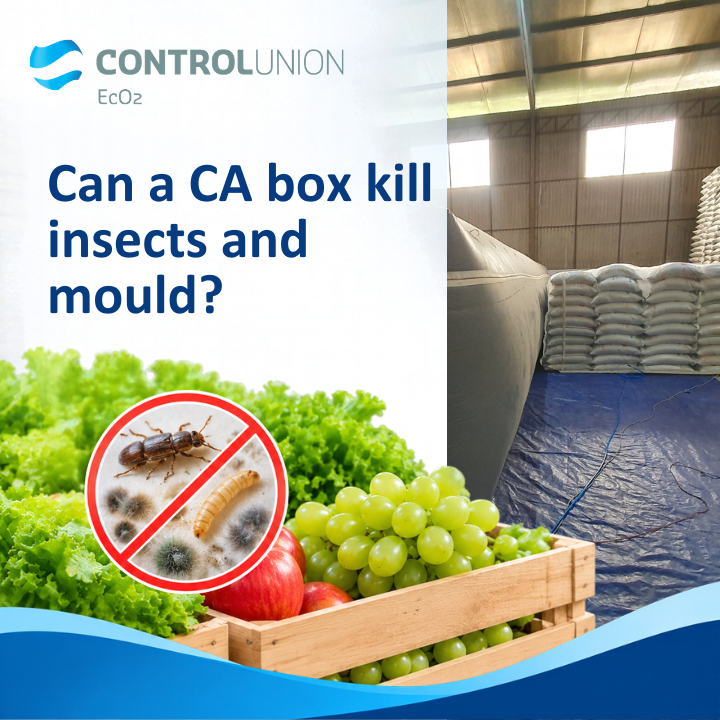
Can a CA box kill insects and mould
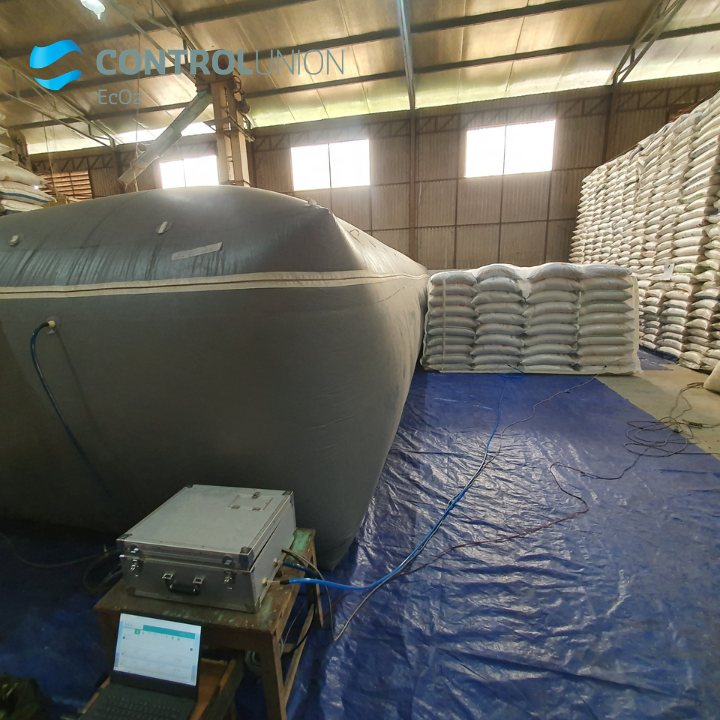
This is a common misconception: many people assume any controlled atmosphere kills weevils. In fact, a fresh produce preservation box is designed to keep produce fresh, so the oxygen level inside must stay above what the produce can tolerate, and that level is usually too high to kill insects. To eliminate insects at every life stage, from eggs and larvae to pupae and adults, EcO2’s controlled atmosphere treatment lowers oxygen below 0.5% in gastight chambers, containers, tents or silos, conditions intended for dry goods.
Far harsher short-term atmospheres have been studied at UC Davis: “Bartlett” pears tolerated 0.25–1% O2 for up to 10 days and 20–80% CO2 for 4–6 days, with responses generally stronger at higher temperatures (Ke, van Gorsel and Kader, 1990). Those are research conditions rather than box operating conditions, and any quarantine treatment must still follow the importing country’s official requirements. For mould, high CO2 combined with low temperature helps limit decay in CO2-tolerant crops such as berries. A CA box is best seen as a way to reduce spoilage risk in storage, not as a phytosanitary procedure.
Which produce suits fresh produce preservation boxes
Not all produce responds to low oxygen in the same way, because respiration rate, CO2 sensitivity and ideal storage temperature differ from crop to crop. According to EcO2, CA boxes apply to four main product groups:
- Fruit: apple, pear, blackcurrant, blueberry, cherry, chestnut, kiwi, plum, redcurrant, table grapes
- Vegetables: asparagus, cabbage, Swiss chard, bean, leek, lamb’s lettuce, new potato, lettuce, turnip, cauliflower, broccoli, sugarloaf, spinach, black radish, cardoon, Brussels sprout, red beetroot
- Mushrooms: chanterelle
- Flowers: rose, tulip
The principle is to keep oxygen and CO2 within the range the product tolerates, enough to slow respiration without pushing it into anaerobic respiration. The right combination depends on cultivar, temperature and storage time, so settings should be confirmed with EcO2’s technical team for each commodity.
How does a CA box integrate with an existing cold room
One of the most practical advantages of fresh produce preservation boxes is that no new warehouse is needed. EcO2’s boxes are designed for existing cold rooms, are easy to install, offer flexible storage, come with a collapsible option for transport and contain no metal components. Investment therefore goes into the modules you need, while your refrigeration infrastructure stays in use.
Integration usually follows three steps. First, the technical team assesses the room’s temperature, stability and cold airflow. Next, both sides choose a configuration for each commodity and storage plan. Finally, a trial run records data and standardises how warehouse staff close and open the boxes.
What is the process for ordering CA boxes for export
Because fresh produce preservation boxes are tied to the physiology of each crop, the most effective way to order is to move from product data to trial, then scale up. This avoids spreading investment across an unproven configuration and produces real data to present to management and buyers. A typical process has six steps:
- Send details of the commodity, volume, target storage time and destination market
- Discuss cold room conditions and a suitable configuration with the technical team
- Run a small-scale trial with a control batch
- Receive a quotation based on volume and form of cooperation
- Install the boxes and train warehouse staff on closing and opening procedures
- Track data and fine-tune settings season by season
Why do exporters choose EcO2
Choosing fresh produce preservation boxes also means choosing the team behind them. EcO2 was established in the Netherlands in 2000, expanded to Vietnam in 2006 and joined Peterson & Control Union in 2010, a global network of inspection and certification operations dating back to 1920. The EcO2 Control Centre and factory are based in Vietnam, giving local businesses access to specialists and equipment without relying entirely on overseas partners.
EcO2’s techniques are used in over 25 countries, with 18,096 cashew, 1,849 rice, 1,730 tobacco and 1,377 wheat treatments completed using non-toxic solutions. Treatment parameters are continuously monitored and collected, which gives customers a data foundation for their quality records.
Turn your existing cold room into a competitive advantage next season. Contact EcO2 today for advice on CA box configuration and a trial plan for your commodity.
Frequently asked questions about fresh produce preservation boxes
The answers below cover the main points to check before planning a trial.
Can a CA box replace methyl bromide fumigation
Not directly. A CA box preserves freshness and is not a quarantine measure, and quarantine requirements always follow the rules of the importing country. For dry goods that need insect control, EcO2’s controlled atmosphere treatment is a non-toxic alternative to chemical fumigation.
Can preservation boxes be used for long sea freight
The boxes are designed for storage in cold rooms and are available in a collapsible version for easy transport. Using them inside reefer containers on long voyages needs specific advice from EcO2 based on the commodity and route.
How much does a CA box cost per kilogram of produce
Cost per kilogram depends on the product, the weight each module holds, the number of cycles per year and whether you buy or rent. Contact EcO2 for a quotation based on your actual volume, then compare it with your own loss rates and selling prices.
Can CA boxes be used for tropical fruit
EcO2’s published list is mainly temperate produce, while tropical fruit such as mango has its own CA recommendations at higher temperatures (10–15°C, 3–5% O2 and 5–10% CO2, according to Kader). Run a small-scale trial with EcO2’s technical team before commercial use.